From "The Point," Episode 3 — featuring Anna Subrizi, Senior Director of Patient Empowerment at Bristol Myers Squibb, in conversation with The Grovery's Chris Ledford
Anna Subrizi has spent her career at the intersection of healthcare information and human understanding. As Senior Director of Patient Empowerment at Bristol Myers Squibb, she oversees programs built to close the distance between what healthcare communicates and what patients and caregivers understand. She is also a co-creator of the Universal Patient Language (UPL), an open-source health literacy framework developed over more than a decade of collaboration with patients, caregivers, and patient advocacy groups.
Setting the Stage for Patient Empowerment
When asked to frame the challenges around patient communications, Anna describes a story in four parts that has played out across her career.
Act One: Identification of an inherent problem—that healthcare often assumes people understand more than they do.
Act Two: A realization early in her career working directly with patients. "Healthcare was often failing patients by communicating in ways they couldn't understand," she says. "Whether this was about how to take their medication, or their insurance coverage, or what follow-ups they needed to do in care, or what was even happening in their body."
Act Three: A solution took shape through her work at BMS. She works on a team that solely focuses on the patient's lived experience, whether it is inviting patients and caregivers to tell their story to inspire others, connecting those stories to BMS teams to share insights, or through Universal Patient Language, which takes patient insights and puts them to work in a framework that fosters understanding, trust, and confidence.
Act Four: The future. Anna and her team are building a collaborative future state in which every patient, caregiver, and healthcare organization shares the responsibility of making healthcare easier to understand and act upon.
More Than Just More
"Patient empowerment" is a phrase that gets used a lot. What Anna describes gives it specificity.
"I think patient empowerment gets misunderstood sometimes," she says. "People hear the word and imagine giving patients more information, more tools, more resources. But empowerment isn't about giving people more. It's about giving people what they need to make decisions."
She scales the challenge plainly: "The healthcare system is full of information. Patients are still searching for understanding, and they just need one tool, person, or experience that explains it the right way."
For Anna, the test is straightforward: Can a patient leave a conversation, appointment, website, or educational resource and answer three questions:
- What's happening to me?
- What are my options?
- What should I do next?
She drives this home with a question worth sitting with: Have you ever left a doctor's appointment and forgotten half of what they told you?
"I think this happens to me almost every time I go," she says. "I leave and I am like, 'I really should have recorded that conversation!' Then I go to work and have conversations with people who are just like me but who have really serious conditions, and I can't even imagine the fear."
And beyond fear, the experience of being a patient—or supporting one—carries a real burden.
"We put the responsibility of care, understanding, researching, paying the bills, and navigating an extremely complex system solely on the patient or caregiver," she says. "And it is a lot."
The gap between information and understanding became concrete for Anna early in her career as a retail pharmacist.
"We'd always ask at the end of a conversation, 'Do you have any questions?' And most of the time, people would say no—not because they understood everything, but because they didn't know what to ask," she says. "You don't know what you don't know. And then a week later, you'd learn that they'd left that experience confused and unsure."
Shouldn't Adding Simplicity Be an Easy Fix?
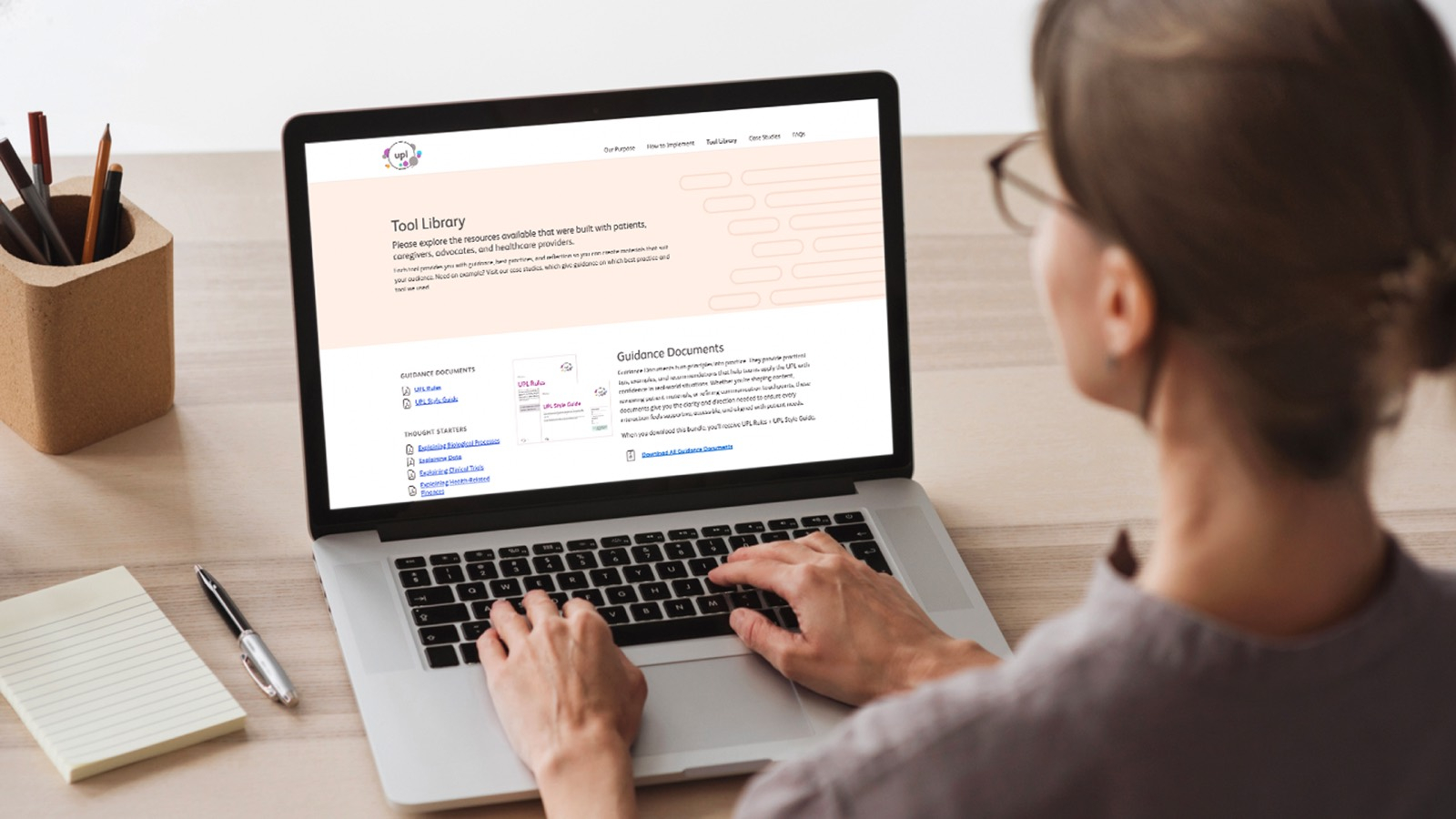
The UPL Tool Library — open-source guidance documents and thought starters at upl.org
While Anna highly doubts there is a covert desire to make information harder for patients to understand, healthcare unintentionally does it every day.
Anna highlights a key friction point: the perception that communicating in plain language means oversimplification. Content that's brought down too many reading levels. Content that might even be insulting to readers.
The remedy is to strike the proper balance between scientifically accurate information that is also clear and understandable.
"I always say this isn't an either-or choice," Anna says. "If information is scientifically accurate but nobody understands it, its value is limited. The same holds true the other way. Patients and caregivers deserve both. They deserve information that is accurate and understandable."
But how do you teach that?
Enter UPL, a patient-first approach to communication that turns complexities into clear, actionable information. It's shaped by nine guiding principles:
- Use Plain Language
- Communicate Visually
- Format Materials for Understanding
- Design for Digital First
- Demonstrate Empathy for Patients and Caregivers
- Enable Patient Learning
- Share Qualitative and Quantified Data
- Be Culturally Responsive
- Empower Caregivers
Anna explains that BMS trains its employees on how to apply UPL to any communication. "We also build AI tools that can help support our employees as they are building content but also serve as a way to help them to consistently practice using UPL."
UPL has helped BMS create greater efficiency in content creation. Collaboration plays a big role across medical, legal, and regulatory teams with ongoing input from patients, caregivers, and advocacy groups.
"We ask, 'What does this community actually need to know?' and then those relationships help us stay honest in the content so we make it easier to understand, while also maintaining the science," she explains.
The Caregiver in the Room
Of all the people navigating the healthcare system, caregivers may be the most overlooked.
"The caregiver is often invisible in the healthcare system," Anna says. "They're in the room, but they're not always acknowledged."
The transition into caregiving isn't always a clear moment. "If someone in your family has a stroke, they become a caregiver instantaneously. It's a drastic shift, and they understand immediately what role they've stepped into," she says. "But when illnesses are chronic and long-standing, or when a loved one is starting to show signs of dementia, that's a longer journey. And when it's gradual, people don't always identify with the word 'caregiver.' They see themselves as a family member. A husband. A wife. 'I'm just here because this is my mom.'"
The weight they carry is real. Caregivers are the ones taking notes, managing medications, scheduling appointments, providing emotional support, and fiercely advocating during difficult conversations. As Anna puts it: you can't truly empower patients without acknowledging that the caregiver is in the room.
That acknowledgment can start with something as simple as language. Instead of calling something "A Caregiver's Guide," reframe it as: "Are you caring for someone you love? This resource is for you."
What It Looks Like When Clarity Takes Hold
The shift that follows commitment to communications that foster patient empowerment, Anna says, is something you can feel.
"We have found at BMS, as we have broad organizational buy-in and leadership support of UPL, that it truly changes the aura of the company. We are putting humans and our communities at the heart of everything we do when we adopt and practice UPL."
The results show up in the data too. "Through surveys and studies, not only are patients and caregivers empowered, they understand more and are more confident in their decisions. But also our organization is empowered with the tools they need to communicate."
A Resource Worth Sharing
The Universal Patient Language framework is an open-source resource, freely available to anyone creating content for patients, caregivers, or the healthcare sector—or in any field where human understanding is the goal. Visit www.upl.org to learn more.
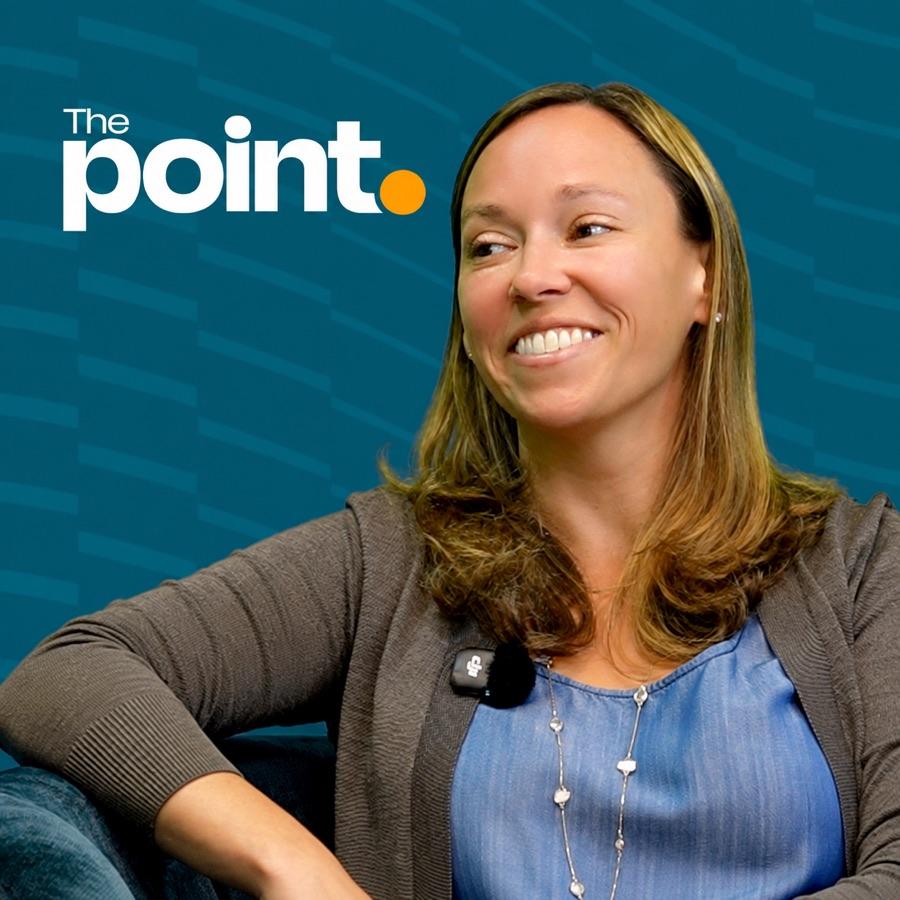
Watch Episode 3 of "The Point"
Anna joined The Grovery's Chris Ledford on Episode 3 of "The Point" to talk about how clear communication empowers patients and caregivers when they are navigating complex information.
Make sure you never miss an episode. Subscribe now.