
We often talk about customer experience, or "CX," as if it lives in a place, within touchpoints like websites, hubs, portals, or call centers. But customers don't experience places. They experience moments.
This is especially true in the pharmaceutical space, where our customers are often patients navigating moments of real vulnerability.
Moments like:
- Hearing a diagnosis
- Opening a letter explaining what insurance will (or won't) cover
- Facing complex paperwork
In moments like these, patients aren't asking, "Is this a well-designed portal?" They are experiencing emotions. And while we aim for positive ones, patients often encounter:
- Frustration with a hard-to-navigate site
- Confusion amid unclear communication
- Alienation within systems that treat them like a number, not a person
In pharma, CX doesn't rise or fall because a touchpoint exists. It rises or falls because of the connection it makes in a moment when trust and confidence are decided.
And yet, most CX efforts still focus on creating yet more assets. If we want better CX, we need to shift our attention away from simply adding touchpoints to intentionally designing moments that cultivate meaning for patients.
That shift starts with shared understanding.
Two Types of Understanding, Defined
Great CX doesn't begin with design systems or channel strategies. It begins with understanding. And not just one kind.
CX requires two kinds of understanding working simultaneously: Lose one, and we get solutions without a North Star. Lose the other, and we get great ideas that go nowhere.
Shared Human Understanding: Seeing the world through the eyes of the people we serve. It asks patients, caregivers, HCPs, pharmacists, case managers:
- What do you need at this moment?
- What scares you?
- What makes you trust, or walk away?
In pharma, high levels of this kind of understanding show up as:
- Adherence
- Streamlined processes
- Long-term brand trust
When we miss human understanding, we deliver information, but not reassurance. Functionality, but not empowerment.
Shared Operational Understanding: Being honest about how work actually gets done and how relevant human understanding is shared inside your company. It asks internal teams:
- Where do handoffs break down?
- Who holds the single source of truth?
- Are teams enabled by consistent training?
- Which internal processes shape better external experiences?
Here's the uncomfortable truth in pharma CX: Much of what patients experience as friction is actually internal friction showing up externally as:
- Confusing communications
- Inconsistent messaging
- Contradictory guidance
And the problems can hide in plain sight.
The Alignment Gap
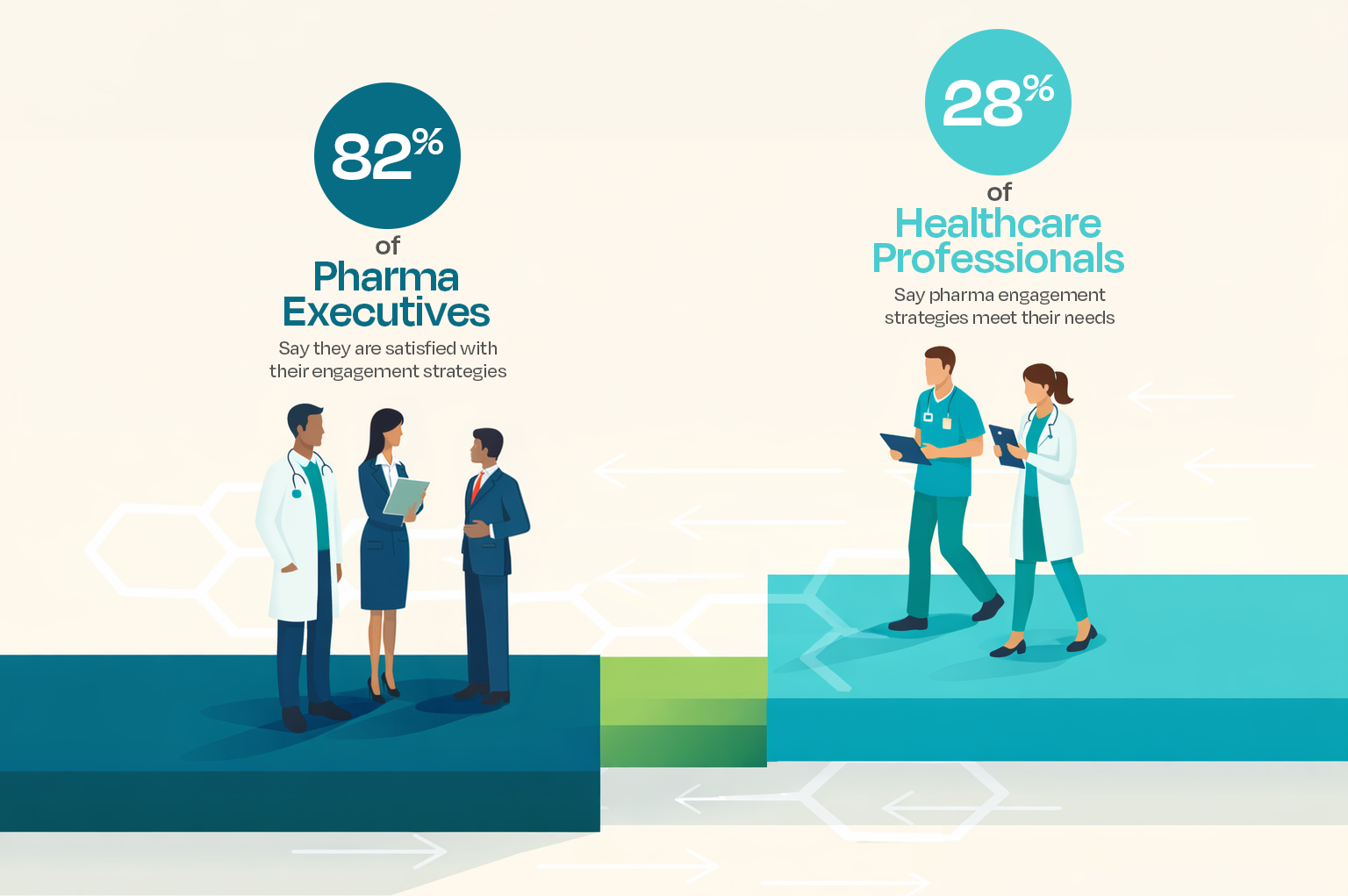
Source: Deloitte
A Deloitte survey of more than 190 healthcare professionals and 50 pharmaceutical executives across top pharmaceutical firms revealed a clear alignment gap between internal confidence and external experience.
Only 28% of HCPs said that pharmaceutical customer engagement strategies met their needs. Meanwhile, 82% of life sciences executives reported being satisfied with their engagement strategies.
That gap is what misalignment looks like. And patients feel it downstream as inconsistent communication, delayed access to therapy, and erosion of trust in the moments that matter most.
Understanding as a CX Discipline
Understanding isn't a one-time research activity. It's a discipline. And when done well, it creates a powerful chain reaction:
Understanding → Alignment → Experience
- Understanding: We learn what's true—not what we hope is true
- Alignment: Teams agree on what it means and what to do about it
- Experience: Patients, caregivers, and providers get information relevant to their lived experiences
The middle step, alignment, is the critical—often overlooked—piece. Without it, insights die in decks, teams interpret understanding differently, and CX stays fragmented.
Three-Step Starter Kit to Align for Better CX
Creating alignment doesn't require a massive transformation program. It requires a repeatable, shared approach.
Step 1: Map the Journey and Identify Friction
- Develop evidence-based personas for audiences—through research often involving psychographic and behavioral data—informing the best paths to creating connection
- Identify moments in the patient journey that truly decide trust
- Diagnose friction in those moments using evidence—data, patient feedback, operational metrics—not internal assumptions, and solve for the friction points. What is going to make the moment more meaningful?
Step 2: Create Common Standards
- Establish communal language; define what "good" looks like
- Clarify ownership in each moment and what behaviors must never vary
- Standardize handoffs, next-step protocol, escalation paths, and channel choreography
Step 3: Operationalize the Experience
- Institute a framework that creates consistency
- Create a single source of truth
- Build playbooks teams can confidently use
- Establish governance to keep standards current
- Train and measure regularly (quarterly, not annually)
That's how understanding becomes alignment. And alignment becomes a consistent experience patients, caregivers, and providers can feel.
Because in the moments that matter most, CX isn't something people notice.
It's something they trust.