
Patient support programs are carrying more weight than ever. Coverage is more complex. Payer mandates are multiplying. HCP administrative burden is climbing. And patients, especially those on specialty or combination therapies, are navigating more friction than any support program was originally built to absorb.
The standard response is to add: more hub resources, more staff, more vendor partnerships, more touchpoints. And yet, enrollment rates stay stubbornly low. Patients still drop off. HCPs still complain that the process is too hard.
What if the barrier is not the program itself?
Noise Is Covering the Real Problem
Research across therapeutic areas consistently identifies the same cluster of PSP pain points: enrollment intake burden, coverage complexity, reverification requirements, high out-of-pocket costs, and limited HCP staff at smaller or non-academic centers. These are real, documented, and genuinely difficult.
But look closer at what drives them. Most of these friction points are not purely clinical or payer-driven. They are coordination failures. They happen at the seams between teams: when market access and patient services are not speaking the same language, when hub vendors are operating off outdated enrollment protocols, when commercial and medical affairs have different definitions of what "supported" means for a patient on a complex regimen.
The external barriers are the symptom. The internal misalignment is the condition.
The Gap Between Perceived and Actual Alignment
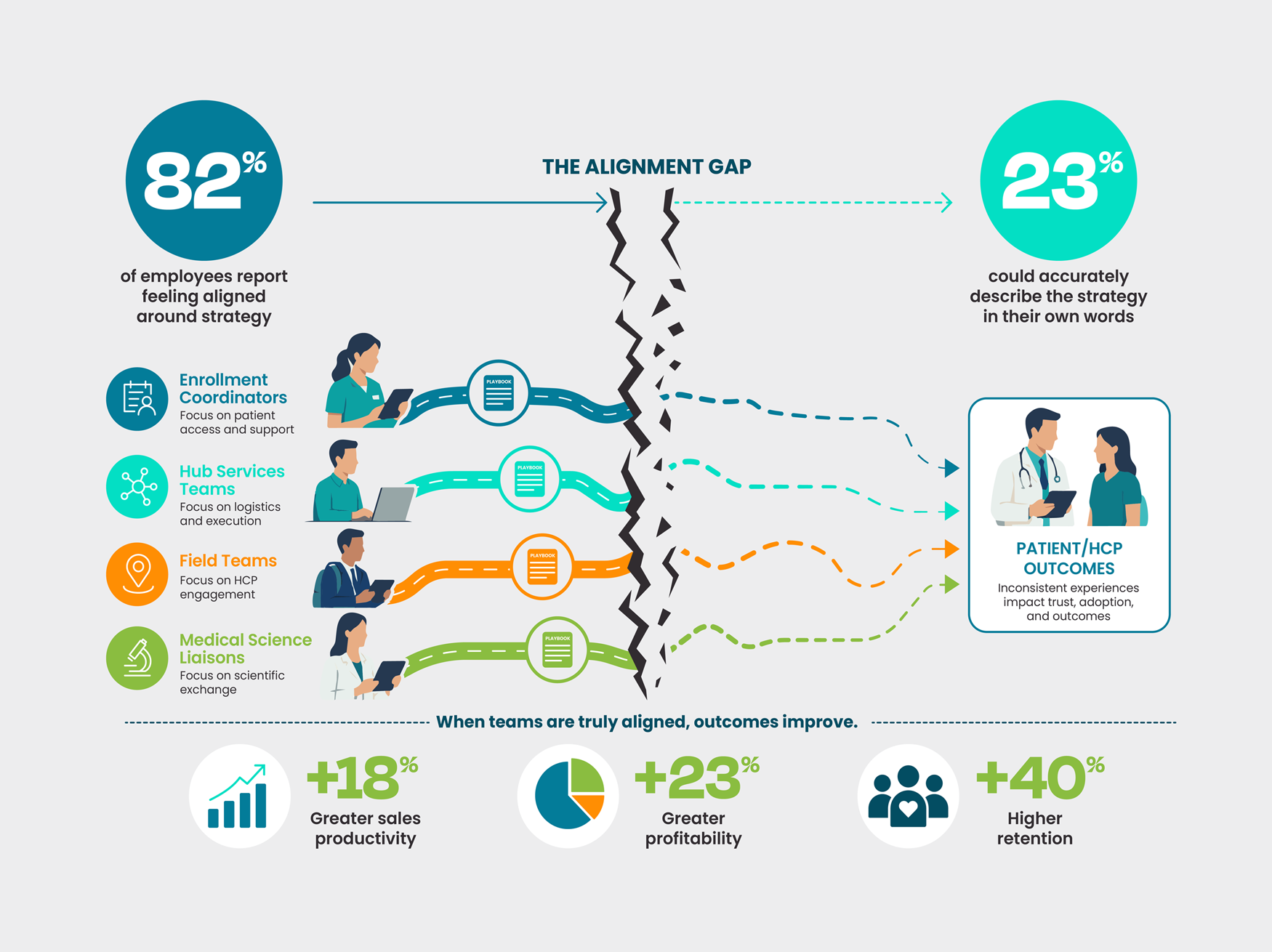
Here is what makes this especially tricky. Research from Harvard Business Review found that 82% of employees across organizations report feeling aligned around strategy. When those same employees were asked to describe that strategy in their own words, actual alignment was just 23%.
That gap shows up in PSP performance. Enrollment coordinators, hub services, field teams, and medical science liaisons can all believe they are working toward the same patient outcome while operating off slightly different playbooks. The patient and the HCP experience that inconsistency directly.
Gallup data shows that highly engaged, aligned teams deliver 18% greater sales productivity and 23% greater profitability. Deloitte research puts mission-aligned companies at 40% higher retention. These are commercial metrics, but the mechanism behind them applies to patient support too: when the people building and running a program are genuinely unified around a shared goal, outcomes improve.
What Alignment Actually Looks Like in a PSP Context
Alignment is not a town hall or a shared slide deck. In a PSP context, it is a set of decisions that get made once and stay made: What is this program promising the patient? Who owns the enrollment experience end-to-end? When a coverage denial happens at the access and reimbursement stage, which team responds, and how fast?
When those questions have clear, consistent answers shared across commercial, medical, market access, hub services, and patient advocacy, the program stops fighting itself. Reverification burden becomes a workflow problem with a workflow solution. Documentation requirements become a coordinated HCP education effort, not a surprise at the point of enrollment.
The programs that perform well tend to have one thing in common: everyone inside the organization who touches the program is working from the same definition of success.
The Starting Point
Identifying where alignment is breaking down is rarely obvious from the inside. It often takes a structured look across functions to see where the seams are and which ones are causing the most friction.
That work, a diagnostic look at how internal teams are aligned around the PSP and its goals, tends to reveal gaps that are fixable. Not through addition of more resources, but through clarity and coordination of the ones already in place.
If your PSP is underperforming relative to what the program was designed to do, the question worth asking is not "what do we need to add?" It is "what do we need to align?"
That is usually where the answer lives.

The Grovery was built to help PSP programs find the answers.
Explore The Grovery Alignment Center, including:
- The Grovery GreenhouseSM Uncover shared missions, priorities, and opportunities.
- BrandPulseSM Sharpen the diagnostic lens on brand truth and performance.
- PersonaFiSM Explore what different audiences actually experience.
Curious where the gaps are in your program? Book a 10-minute reality check with me.